
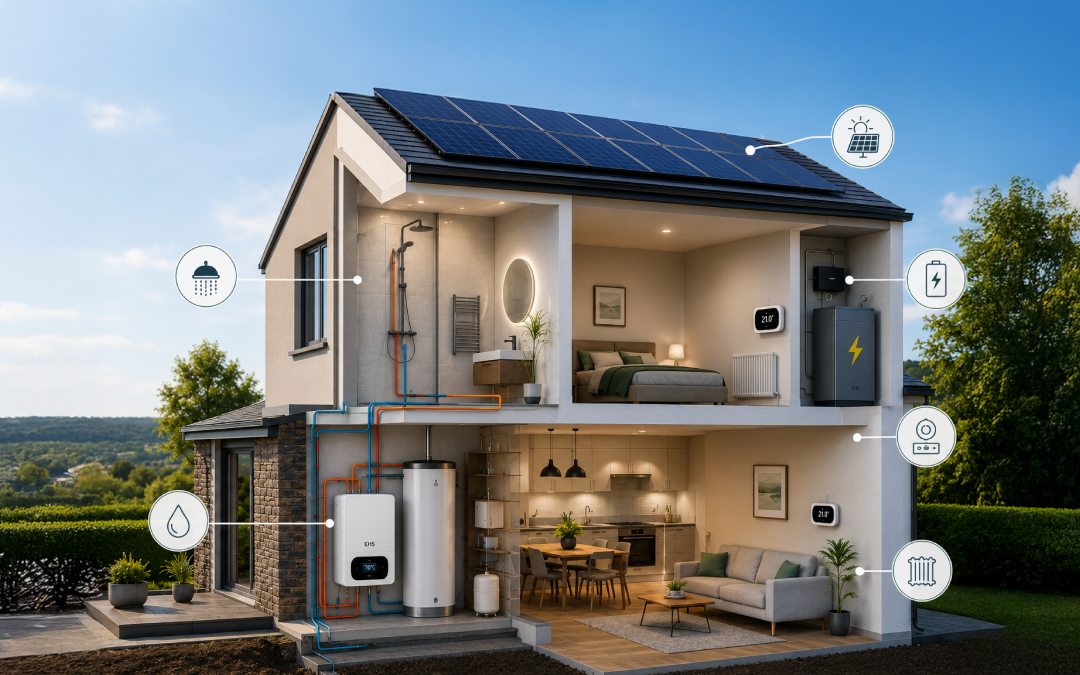
The UK heating market is changing quickly.
More homes are being built, converted, extended or refurbished without a simple gas connection. Flats, apartments, garden rooms, annexes, holiday homes, park homes, small new builds and rural properties all need practical answers to the same question:
How do we heat this property properly if gas is not available, not wanted, or not the best long-term choice?
At Electric Heating Systems, we believe the answer should start with good engineering, not just a boiler.
That means looking at the whole system from the beginning:
- The building fabric
- The heat loss
- The electrical supply
- The hot water demand
- The heating emitters
- The controls
- The available roof space for solar PV
- The potential for battery storage
- The opportunity to recover shower waste heat
- The customer’s real 10-year cost
- The practical installation constraints
Only after those questions have been considered should anyone choose the appliance.
That is why our message is simple:
Fabric first. System design second. Product third.
This article explains where electric boilers fit, why merchants should understand the category, how EHS Flex helps installers solve real-world problems, and why specifiers should look at electric boilers as part of a whole-system design rather than a standalone product.
Electric boilers are not the correct answer for every property. Sometimes gas, oil, LPG or a heat pump may be cheaper over 10 years. If that is genuinely the case, a good engineer should say so.
But in the right property, especially a low-heat-loss home without gas, a well-designed electric boiler system can be clean, quiet, compact, low-maintenance and surprisingly practical — particularly when combined with good fabric, waste water heat recovery, solar PV, battery storage and sensible controls.
Why Merchants Should Pay Attention to Electric Boilers
For merchants, electric boilers are no longer just an emergency product for properties where gas is not available.
They are becoming part of a wider conversation about electrification, low-carbon design, small homes, fabric-first upgrades, apartment heating, holiday accommodation, park homes, garden rooms and buildings where an outdoor heat pump unit is not practical.
But there is a problem in the way electric boilers are often sold.
A customer asks for “an electric boiler”.
The branch asks “what size?”
The product is sold like a fixed-output box.
The installer then discovers the electrical supply is limited, the hot water demand is different from expected, or the property only needs a fraction of the output.
That is not good engineering.
A better merchant conversation starts with the application:
- What type of property is it?
- Is there gas?
- What is the heat loss?
- What electrical supply is available?
- Is the customer using a shower, bath, or multiple outlets?
- Is there space for a cylinder?
- Are there existing radiators?
- Is there solar PV or battery storage?
- Is waste water heat recovery possible?
- Is the customer trying to improve SAP, reduce carbon, reduce noise, reduce installation complexity or reduce 10-year cost?
This is where the EHS Flex range gives merchants a stronger offer.
The key principle is: Match the boiler to the building, not the building to the boiler.
A flexible electric boiler range gives branch staff and installers a better way to handle real-world jobs. Instead of simply choosing a fixed size, the installer can match output more closely to the property and available supply.
For merchants, this creates a better product story, fewer awkward applications, more add-on sales and a more professional conversation with installers.
The branch is no longer just selling a boiler.
It is helping the installer design a better heating system.
Where Electric Boilers Fit Best
Electric boilers are strongest where the building is suitable.
They are not a universal replacement for gas or heat pumps. They are part of the solution for specific property types and project constraints.
Flats and apartments
Flats often have space limitations, flue restrictions, leasehold issues, landlord requirements or no gas connection. An electric boiler can provide wet central heating without a flue, gas supply or outdoor unit.
For a smaller low-heat-loss flat with one bathroom and shower-led hot water demand, an electric combi boiler can be a practical, compact solution.
Garden rooms and annexes
Garden rooms, home offices, studios and annexes often need independent heating. Extending the main house heating system may be expensive or impractical, and the electrical supply may be limited.
A correctly selected electric boiler gives these spaces wet central heating without gas pipework or an external heat pump unit.
Holiday homes and park homes
Holiday homes and park homes often operate with limited electrical supplies. In these applications, output control is critical.
A boiler that can respect the available supply is more useful than a boiler that simply demands more current than the site can provide.
Small new builds and highly insulated homes
As building fabric improves, heat losses come down. A small, well-insulated home may only need a modest amount of heat for much of the year.
In these buildings, the heating system should not be chosen by habit. It should be chosen by demand.
Off-gas properties
For homes without gas, the customer may be considering oil, LPG, direct electric, heat pumps, biomass or electric wet central heating.
Each option has strengths and weaknesses.
Electric boilers are attractive where the priorities are compact installation, no fuel storage, no combustion from the appliance, low maintenance, quiet operation and straightforward wet central heating.
Fabric First: The Cheapest Energy Is the Energy You Never Use
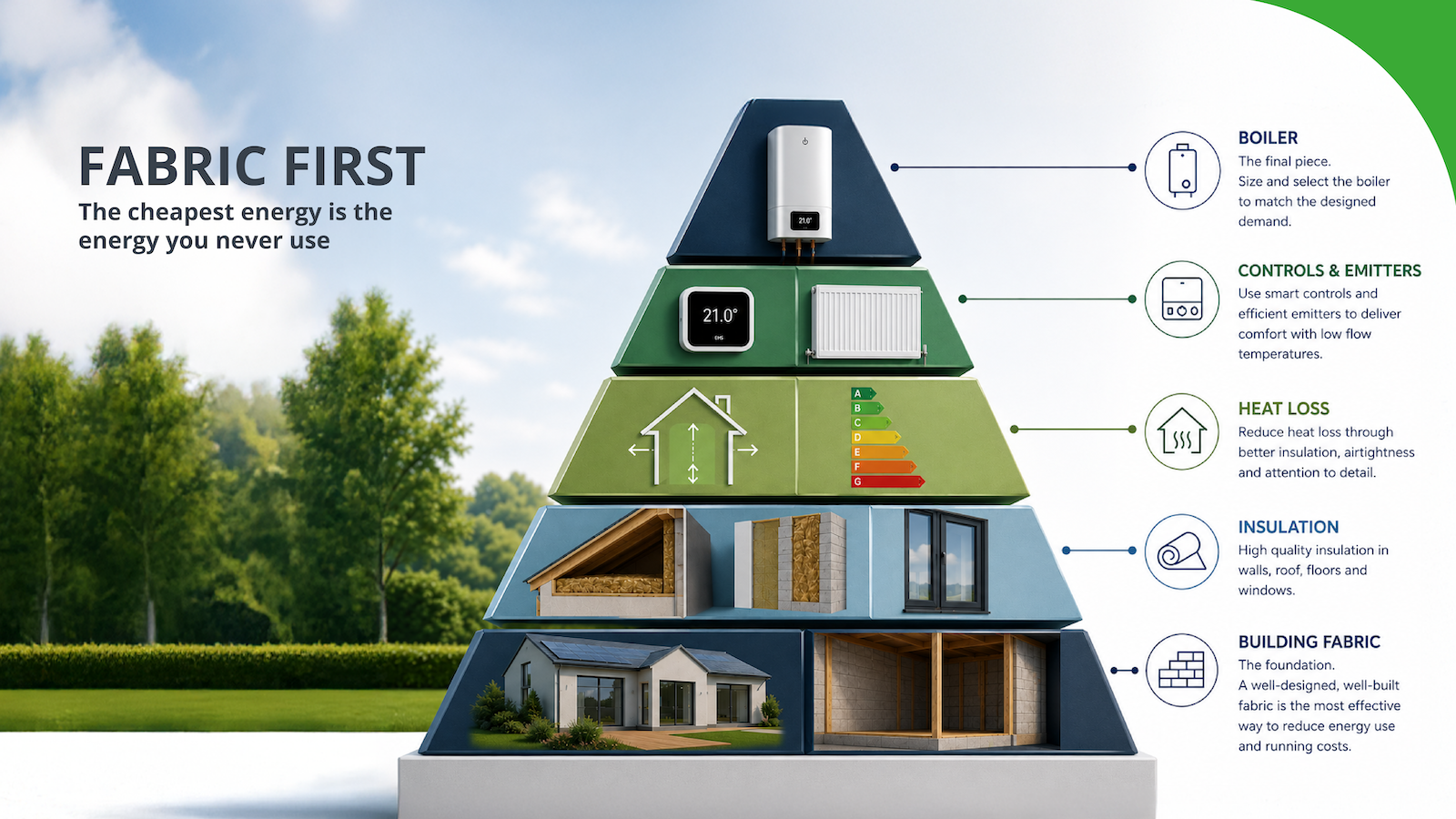
Before choosing any heating appliance, the first question should be:
How can we reduce the amount of heat the property needs?
This is the fabric-first principle.
A building with poor insulation, uncontrolled draughts, weak glazing, thermal bridges and poor ventilation will make any heating system more expensive to run.
A better building needs less heat.
That matters because it affects everything that follows:
- The boiler can be smaller
- The electrical load can be lower
- The heating circuit can run more gently
- The rooms can feel more comfortable
- The risk of condensation and mould can be reduced
- The annual running cost can fall
- The customer experience improves
For merchants, fabric first creates a better conversation with installers.
For specifiers, it supports compliance and better energy modelling.
For homeowners, it creates a warmer, healthier, more comfortable home.
For EHS, it is central to our engineering approach.
We do not believe the right answer is always “fit a bigger boiler”.
Very often, the right answer is:
Improve the building, calculate the heat loss, then choose the smallest practical system that meets the demand.
Whole-System Design: The Real Opportunity
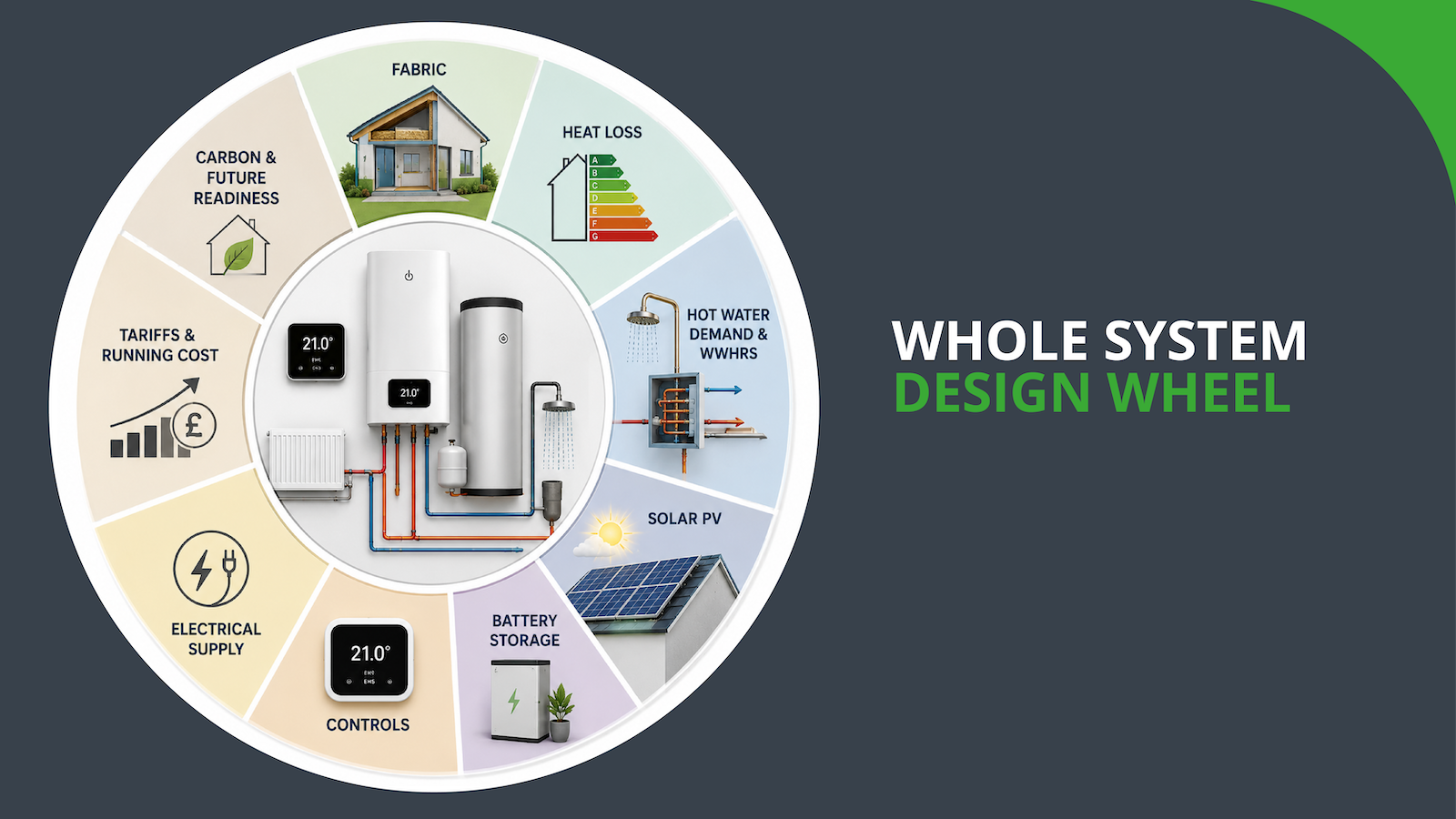
The biggest mistake in heating is to look at the appliance in isolation.
A boiler does not perform on its own. It is part of a system.
A good electric boiler installation should consider:
- Building fabric
- Heat loss
- Hot water usage
- Shower flow rates
- Pipe lengths
- Cylinder losses
- Heating controls
- WWHRS
- Solar PV
- Battery storage
- Time-of-use tariffs
- Electrical supply
- User expectations
This is where EHS wants to change the conversation.
Instead of asking:
“Which electric boiler should I fit?”
we should ask:
“What is the best complete heating and hot water system for this property?”
That question leads to much better outcomes.
For a small flat, the answer may be an electric combi, short hot water pipe runs, a controlled shower flow rate, WWHRS and solar PV where available.
For a family home with baths, the answer may be a system boiler and cylinder.
For a park home, the answer may be a supply-limited Flex+ boiler.
For a larger rural property, the answer may be oil, LPG or a heat pump if the 10-year cost and practicality are better.
This level of honesty builds trust.
It also helps merchants and installers avoid mis-selling.
Heating Only the Hot Water the Property Actually Needs
Domestic hot water is often the part of the design that makes or breaks the system.
A one-bedroom flat with a single shower does not need the same hot water strategy as a family home with baths and multiple bathrooms.
This is where an electric combi boiler can work very well in the right application.
An electric combi produces hot water when the customer uses it. There is no domestic hot water cylinder sitting hot all day if the property does not need one.
For smaller homes with modest hot water demand, that can mean:
- Less plant space
- Fewer stored water losses
- Simpler installation
- Lower capital cost
- Hot water produced only when required
- Easier siting in compact properties
This is not a claim that electric combis are right for every property.
They are not.
If the customer wants fast bath filling, multiple outlets, high hot water storage or family-level demand, a system boiler and cylinder may be a better design.
But where the property is shower-led and compact, heating only the hot water that is actually needed is a sensible engineering principle.
It also supports the wider SAP and HEM conversation. As homes become better insulated, hot water becomes a larger proportion of total energy demand. Reducing unnecessary hot water energy and avoiding avoidable standing losses can therefore be important.
WWHRS: Recovering Heat That Would Otherwise Go Down the Drain
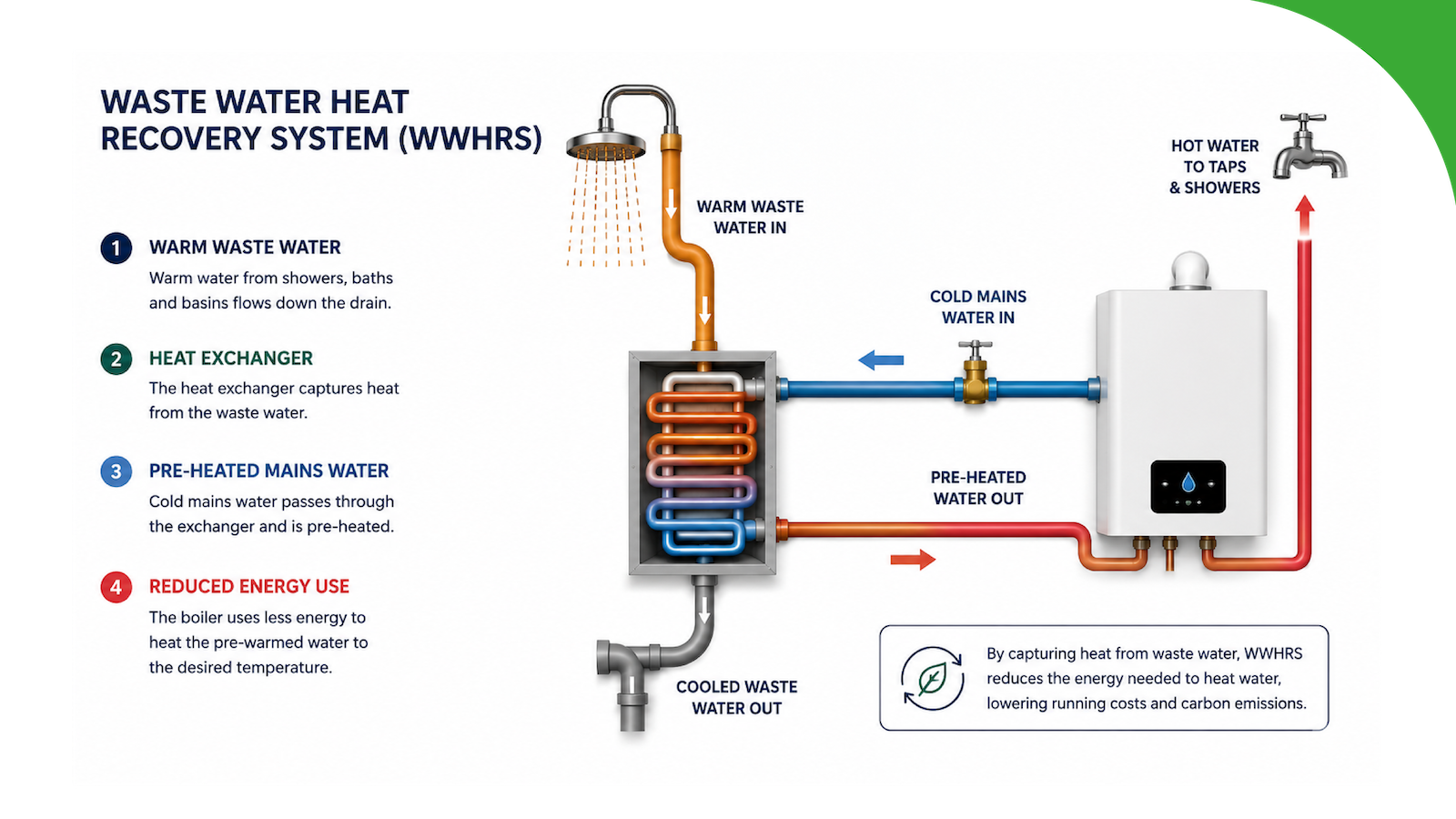
Waste Water Heat Recovery Systems, usually shortened to WWHRS or WWHR, are one of the most useful simple measures for shower-led homes.
The principle is easy to understand.
When someone takes a shower, warm waste water leaves through the drain. A WWHRS unit transfers some of that heat into the incoming cold mains water. The boiler then has less work to do to raise the water to shower temperature.
This works particularly well with electric combi applications because the shower is often the main hot water load.
If the boiler, shower and WWHRS unit are located close together, and the pipework is designed sensibly, the benefit can be even better. Short pipe runs reduce losses and help the system respond quickly.
For merchants, this creates a strong system sale:
- EHS Flex Combi
- WWHRS unit
- Flow restrictor where appropriate
- Thermostatic shower
- Controls
- Magnetic filter
- Inhibitor
- Correct installation kit
For specifiers, WWHRS can be a useful SAP improvement because recognised products can be entered into the calculation.
For installers, it is a practical add-on that helps the hot water side of the job.
For homeowners, it is easy to understand:
Instead of wasting shower heat down the drain, recover some of it and use it again.
This is exactly the type of simple engineering improvement that supports the EHS philosophy.
Do not just fit a boiler.
Design the system properly.
Solar PV and Batteries: Using Homegrown Electricity More Intelligently
Electric boilers use electricity directly, so the source and timing of that electricity matter.
Where a property has solar PV, some of the electricity used in the home can be generated on site. Where a battery is installed, more of that solar electricity can be stored and used later instead of being exported.
This does not make heating “free” over the full lifetime of the system, because solar panels and batteries have capital costs.
But it can mean that at certain times, the boiler is using electricity generated by the property itself rather than importing electricity from the grid at that moment.
That is a powerful message for the right customer:
Use more of your own clean electricity in your own home.
For a small, well-insulated home, this can strengthen the case for electric heating.
The best applications are usually those where the heat demand is low and controllable:
- Flats with low heat loss
- Small new builds
- Garden rooms
- Annexes
- Holiday homes
- Park homes
- Properties with daytime occupation
- Homes with PV and battery storage
- Homes using time-of-use tariffs
A whole-system electric design might include:
- Fabric-first improvements
- EHS Flex boiler matched to heat loss
- WWHRS for showers
- Solar PV
- Battery storage
- Good heating controls
- Sensible hot water expectations
- Time-of-use tariff awareness
This is where an electric boiler becomes part of a larger energy strategy rather than a standalone appliance.
The future of domestic energy is not just about what appliance is on the wall.
It is about how the home produces, stores and uses electricity.
SAP 10.3 and HEM: Why the Conversation Is Changing
For specifiers, SAP 10.3 and the Home Energy Model are important because they change the way heating technologies are compared.
Electricity now performs much better in carbon terms than it did under older SAP assumptions, reflecting the decarbonisation of the UK electricity grid.
That helps electrically powered heating systems in carbon calculations.
However, running cost still matters. Electricity remains more expensive per kWh than gas in typical assumptions, and a direct electric boiler does not have the coefficient of performance advantage of a heat pump.
So the EHS message is not:
“Electric boilers beat heat pumps.”
The better message is:
“In the right low-heat-loss property, with the right hot water strategy, WWHRS, solar PV, batteries and controls, an electric boiler can be a practical low-carbon solution with major installation advantages.”
This is especially important for small or constrained properties where a heat pump may be difficult because of:
- Outdoor unit location
- Noise considerations
- Planning or visual constraints
- Refrigerant circuit requirements
- Cylinder space
- Emitter upgrades
- Higher installation disruption
- Leasehold or landlord restrictions
In these situations, the SAP or HEM discussion should consider the complete system.
That means looking at:
- Fabric demand
- Hot water demand
- WWHRS
- Solar PV
- Battery storage
- Controls
- Electricity tariff
- Installation cost
- Maintenance
- Noise
- Practicality
When all of those are considered, electric boilers can have a strong role in suitable properties.
Not because they are always the most efficient appliance.
But because the whole installed system may be simpler, quieter, cheaper to install, easier to maintain and better suited to the building.
Noise, Siting and Installation Payback
A heating system has to work in the real world, not just on paper.
A heat pump may be an excellent choice for many homes, particularly where the building is well suited, emitters are correctly designed and outdoor space is available.
But in some projects, practical barriers can make the installation more expensive or less attractive.
There may be limited outdoor space.
There may be acoustic concerns.
There may be leasehold restrictions.
There may be visual constraints.
There may be long pipe runs.
There may be a need for emitter upgrades.
There may be limited cylinder space.
There may be planning concerns.
In these cases, a compact electric boiler can sometimes provide a better payback in the real project, even if another technology appears more efficient in isolation.
Why?
Because payback is not only about appliance efficiency.
It is also about:
- Capital cost
- Installation labour
- Disruption
- Maintenance
- Space
- Noise
- Siting
- Controls
- Customer expectations
- Available energy sources
An EHS electric boiler has no outdoor fan unit, no flue, no refrigerant circuit and minimal moving parts. It can usually be sited internally and connected to a wet heating system.
For many compact homes, that simplicity has value.
When combined with WWHRS, PV, batteries and good fabric design, the total package can be very compelling for the right application.
The Current EHS Flex Product Range
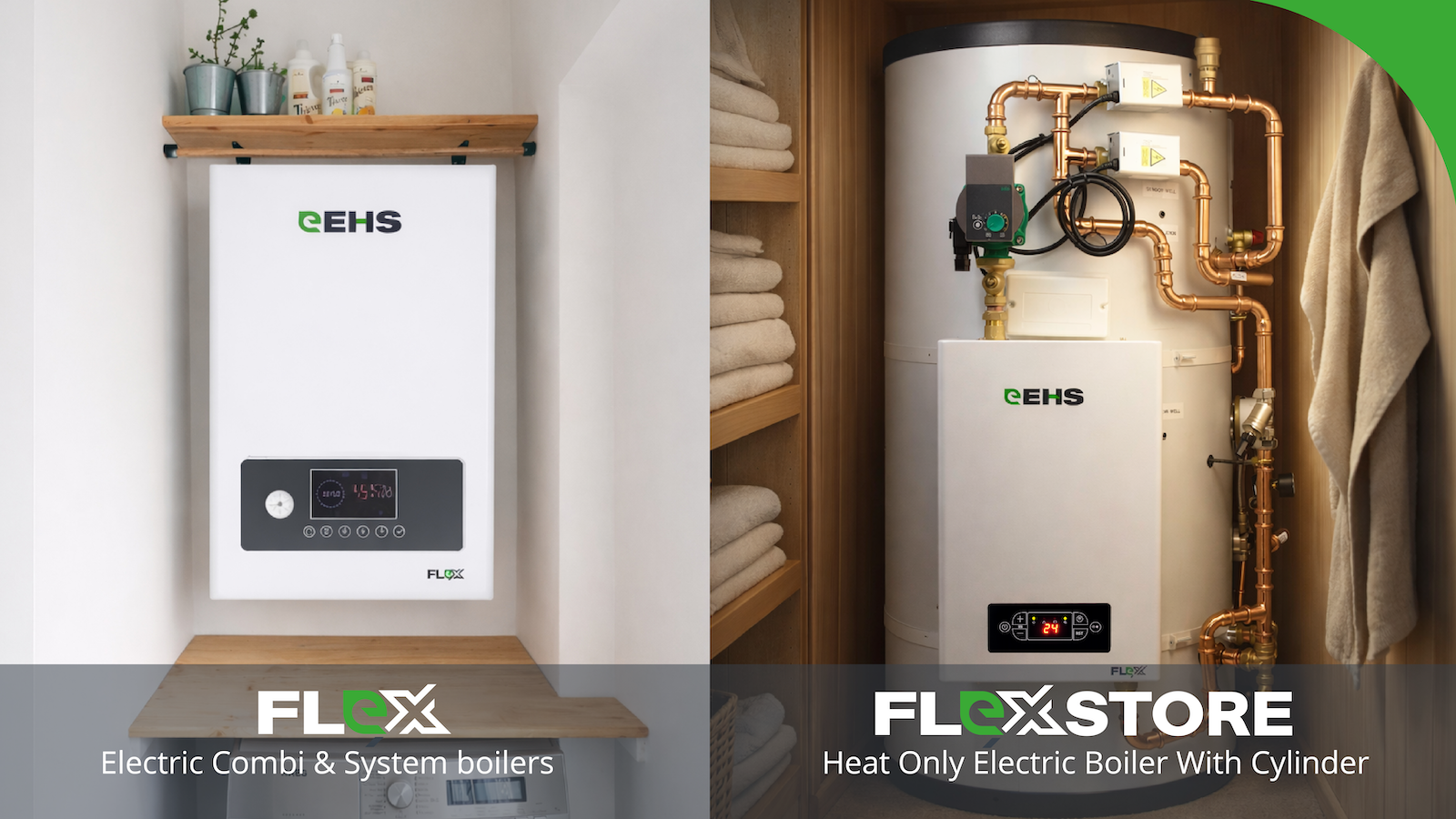
The EHS Flex range is designed around practical electric wet central heating.
It gives merchants, specifiers and installers a flexible set of options for homes without gas.
Flex Electric Combi Boiler
The Flex Electric Combi is designed for smaller homes and flats with a single bathroom and modest hot water demand.
It provides heating and hot water from one compact appliance and is most suitable where the customer’s hot water requirement is shower-led rather than bath-heavy.
Key advantages include:
- No gas supply required
- No flue required
- Compact siting
- Works with wet radiators
- Integrated pump and expansion vessel
- Range-rateable output
- Minimal moving parts
- Quiet operation
- Suitable for small flats and low-heat-loss homes
- Can work well with WWHRS where the shower and boiler are sited close together
- Can be part of a wider solar PV and battery strategy
The important point is honest application.
The Flex Combi is not for every home. It is strongest where the building is compact, the heat loss is low, the hot water demand is realistic and the customer wants a simple non-gas solution.
Flex Electric System Boiler
The Flex System Boiler is for wet central heating systems where domestic hot water is provided separately, usually with a cylinder.
This is often the better choice where the property has:
- A bath
- Higher hot water demand
- Multiple outlets
- A requirement for stored hot water
- Existing wet heating
- Underfloor heating
- A cylinder-based design
The system boiler route gives specifiers and installers more flexibility. It can be paired with vented or unvented cylinders and can serve radiators or underfloor heating.
Key advantages include:
- No gas supply required
- No flue required
- Range-rateable heating and hot water
- Works with existing radiators
- Suitable for cylinders
- Integrated pump and expansion vessel
- Minimal servicing
- Quiet operation
- Compact siting
- Can be integrated into renewable electricity strategies
Flex+
Flex+ is particularly important for supply-limited applications.
Many holiday homes, park homes, caravans and small buildings operate on limited electrical supplies. In those cases, the challenge is not only heating demand. It is available current.
Flex+ is designed to respect constrained supplies and adjust output accordingly.
This makes it especially relevant for:
- Park homes
- Static caravans
- Holiday homes
- Annexes
- Small buildings
- 32 A supply-limited sites
- Locations where LPG or oil storage is undesirable
For merchants, Flex+ gives a clear and easy product story:
Wet central heating for homes where the electrical supply has to be managed carefully.
Why Flexibility Matters More Than Maximum Output
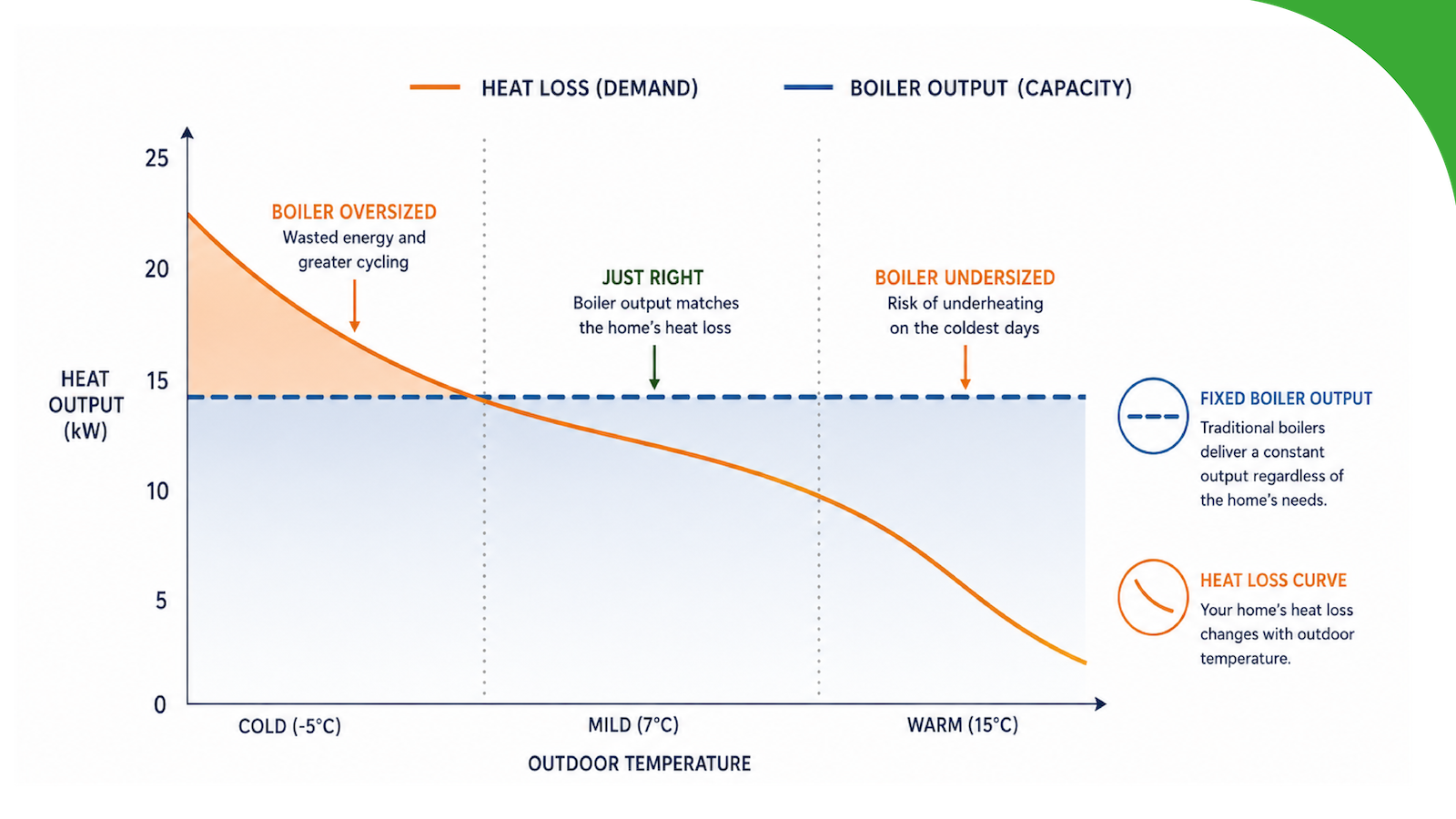
Bigger is not always better.
A 14 kW boiler in a property with a 3 kW heat loss is not automatically a better heating system. If the building only needs 3 kW, the key is not maximum output. The key is control.
Good design means matching the boiler output to the heat loss and the available supply.
The EHS Flex range allows the installer to adjust output to suit the property. That helps avoid oversizing, wasted capacity and unnecessary electrical demand.
For merchants, this is a strong point of difference.
Many electric boilers are sold as fixed-output appliances. EHS Flex gives branches a more adaptable range that can serve more real-world applications.
For installers, it means they can commission the appliance more intelligently.
For specifiers, it supports the principle of designing around calculated demand rather than assumption.
The Merchant Sales Message
For merchants, the opportunity is not just to stock electric boilers.
The opportunity is to own the conversation around heating homes without gas.
A branch can say:
“If the property has no gas, let’s look at the whole system: heat loss, electrical supply, hot water demand, WWHRS, solar PV, battery storage and the right Flex boiler.”
That is a far stronger message than:
“Here is an electric boiler.”
It also creates better add-on sales:
- Magnetic filters
- Inhibitor
- Filling loops
- Valves
- Controls
- Cylinders
- WWHRS
- Flow restrictors
- Thermostatic showers
- Installer kits
- Electrical accessories
- Renewable energy conversations
The merchant becomes part of a better design process.
This helps installers, improves customer outcomes and creates more complete branch sales.
The Specifier Message
For specifiers, the EHS message is deliberately balanced.
We are not saying electric boilers are always the answer.
We are saying they can be the right answer when the whole system is designed properly.
A strong EHS specification might include:
- Fabric-first design
- Correct heat-loss calculation
- Electric boiler output matched to demand
- Electrical supply assessment
- Combi hot water where demand is modest
- System boiler and cylinder where stored hot water is required
- WWHRS for shower-led dwellings
- Short hot water pipe runs
- Solar PV where roof area allows
- Battery storage where self-consumption is valuable
- Heating controls
- Clear user expectations
- Low-noise internal plant
- No flue or outdoor unit requirement
This is particularly useful where gas is unavailable, an outdoor unit is difficult, or the project needs a quiet, compact, low-complexity heating solution.
The specifier should not ask:
“Is an electric boiler better than a heat pump?”
The better question is:
“Which complete system gives this dwelling the best balance of SAP performance, carbon, cost, noise, space, buildability and user experience?”
That is where EHS Flex can be a valuable option.
The Installer Message
For installers, the EHS Flex range is about practical control.
The installer should not simply fit the highest output available.
Good installation practice means:
- Understand the building
- Estimate or calculate heat loss
- Check the incoming electrical supply
- Confirm cable and protective device requirements
- Choose combi or system boiler correctly
- Confirm hot water expectations
- Consider WWHRS where showers dominate
- Keep pipe runs sensible
- Range-rate the boiler where appropriate
- Use correct controls
- Protect the heating circuit
- Commission the system properly
For combi installations, hot water expectations are especially important.
A 14 kW electric combi is suitable for properties with a single shower, but it should not be sold as a fast bath-filling appliance. Where baths or higher hot water demand are required, a system boiler and cylinder is usually the more professional recommendation.
This honesty protects the installer and the customer.
It also protects the merchant from product complaints caused by incorrect application.
The Homeowner Message
For homeowners, the message should be simple.
You do not need to know every technical detail, but you do need a heating system that suits your home.
An EHS electric boiler may be right if:
- You do not have gas
- You want wet central heating
- You want a compact appliance
- You do not want an outdoor unit
- You want quiet operation
- You want no combustion from the heating appliance
- You have a small or well-insulated home
- You have modest hot water demand
- You have solar PV or battery storage
- You want to use more home-generated electricity
- You want low maintenance
- You want a simple installation
But the best starting point is still the building.
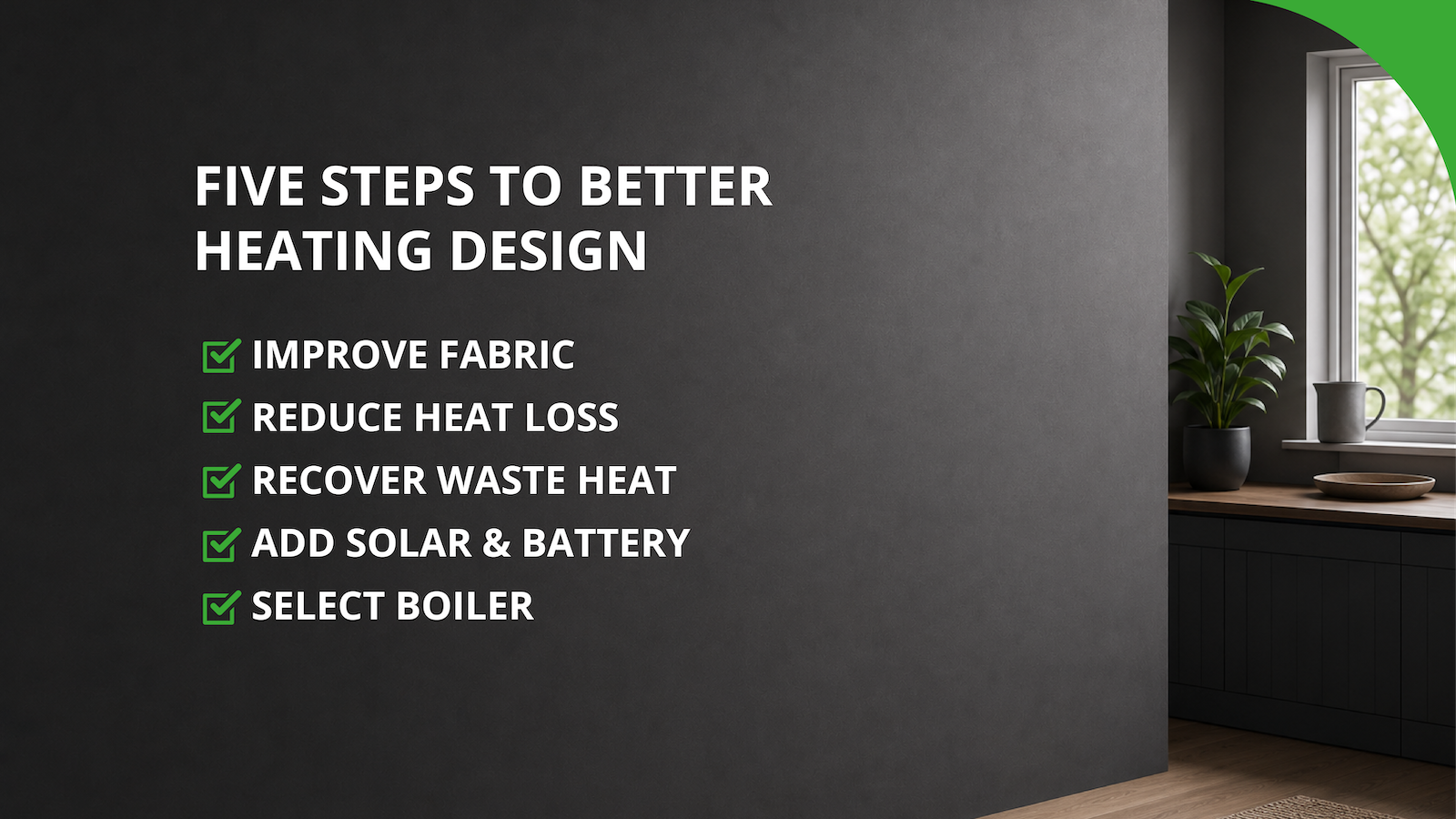
Improve the fabric where you can.
Reduce heat loss.
Choose the right hot water design.
Recover wasted shower heat if possible.
Use solar electricity intelligently.
Then choose the right boiler.
That is how a home becomes warmer, cleaner, quieter and more efficient.
Clean and Healthy Homes
Heating is not only about temperature.
A good home should be warm, dry, well ventilated and comfortable.
Cold homes, damp, mould and poor indoor air quality can all affect health and wellbeing.
Electric boilers do not burn fuel inside the appliance. They produce no combustion gases from the boiler, require no flue and create no carbon monoxide from the heating appliance itself.
That is a reassuring message for families, landlords and people who care about indoor air quality.
It should not be presented as a fear campaign against gas. Modern gas appliances are designed to operate safely when correctly installed and maintained.
The stronger, more credible message is:
Electric heating gives customers a non-combustion route to wet central heating.
When combined with good insulation, ventilation and moisture control, that can support a warmer, cleaner and healthier indoor environment.
This matters especially for families with children, people with asthma concerns, landlords, housing providers and customers trying to create a greener home.
The Bigger Picture: Heating Homes Without Gas
The future of heating will not be one technology for every building.
It will be better system design.
Some homes will suit heat pumps.
Some will remain on gas or oil for longer.
Some will need hybrid systems.
Some will use direct electric.
Some will suit electric wet central heating.
The important point is to choose based on the property, not fashion.
At EHS, our position is clear:
We help homes without gas choose practical, clean and well-engineered heating solutions.
That starts with the building.
It continues with hot water, WWHRS, solar PV, batteries, controls and electrical supply.
Only then does it arrive at the boiler.
For merchants, this creates a stronger branch conversation.
For specifiers, it creates a credible SAP and HEM strategy.
For installers, it creates better installations.
For homeowners, it creates warmer, cleaner, quieter homes.
The EHS Flex range is not just a set of electric boilers.
It is a flexible product family designed to support real-world heating applications where gas is not available, not wanted or not the best practical answer.
The best summary is this:
Reduce the demand. Recover wasted heat. Use homegrown electricity where possible. Match the boiler to the building. Keep the system simple.
That is whole-system electric heating.
That is where EHS Flex fits.
And that is why merchants, specifiers and installers should take electric boilers seriously, not as a universal answer, but as a practical and valuable part of the modern heating toolkit.