
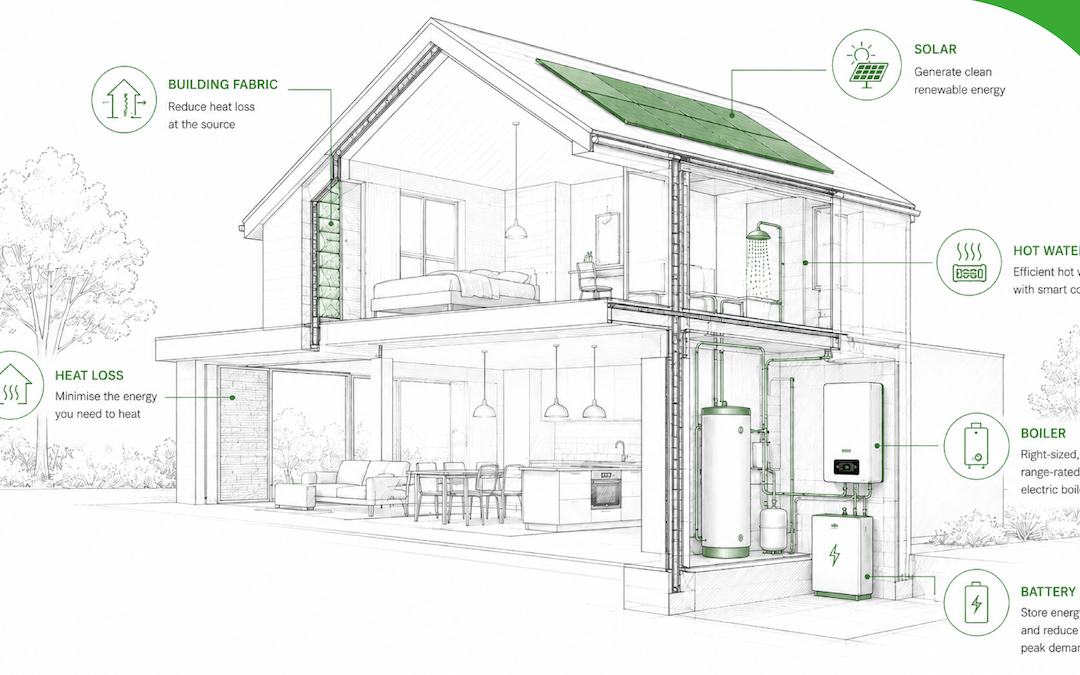
Five years ago, I moved from the automotive and plastics industry into heating. It has been brilliant, frustrating, technical, political and occasionally baffling…..often all in the same week!
One thing hit me from the outset : in heating, the conversation almost always starts with the appliance, before even looking at the property. That still feels back to front to me. In engineering, the task comes first. You would not use an earthmover to pop to the shops, just as you wouldn’t use a scooter to tow a car. You choose the machine has to suit the job at hand.
Heating should be no different but it is and I can see why. For years, the easy answer was gas. A 24 kW to 42 kW combi boiler went into almost everything. It was familiar, compact, relatively cheap to install and well understood.
Whilst the thermal specification for new-build housing has improved enormously over the last 30 years, we have continued to install the same old gas boilers often hearing the boiler size based on ‘how many radiators does it have’ or ‘how many bedrooms’.
The buildings are now better insulated and therefore heat losses are much lower. Carbon targets are tighter. Solar PV and batteries are becoming more relevant. Hot water demand is often more important than space heating and the compliance route is no longer just about fitting the appliance everybody knows.
Gas will not disappear overnight, but it is much harder to justify in homes built in the last 30 years.
There isn’t a document that says “no gas boilers”, but the reality is that the standards are moving the industry toward low-carbon, fabric-first, electricity-based homes. Once carbon, primary energy, fabric performance, renewables, plant space, safety, flues and carbon offset payments are all considered, the old gas default starts to look much less comfortable.
…..and, just when you think there’s another Eco warrior out to have a go at fossil fuels,…..shock! horror!, ASHP’s will not be the answer in many of the new smaller properties!!….and why are you having a go at the brilliant ASHP’s I hear you ask? …..it’s a simple question of maths and the Low Energy Demand Paradox….. which I’ll explain later.
The Standards Are Changing
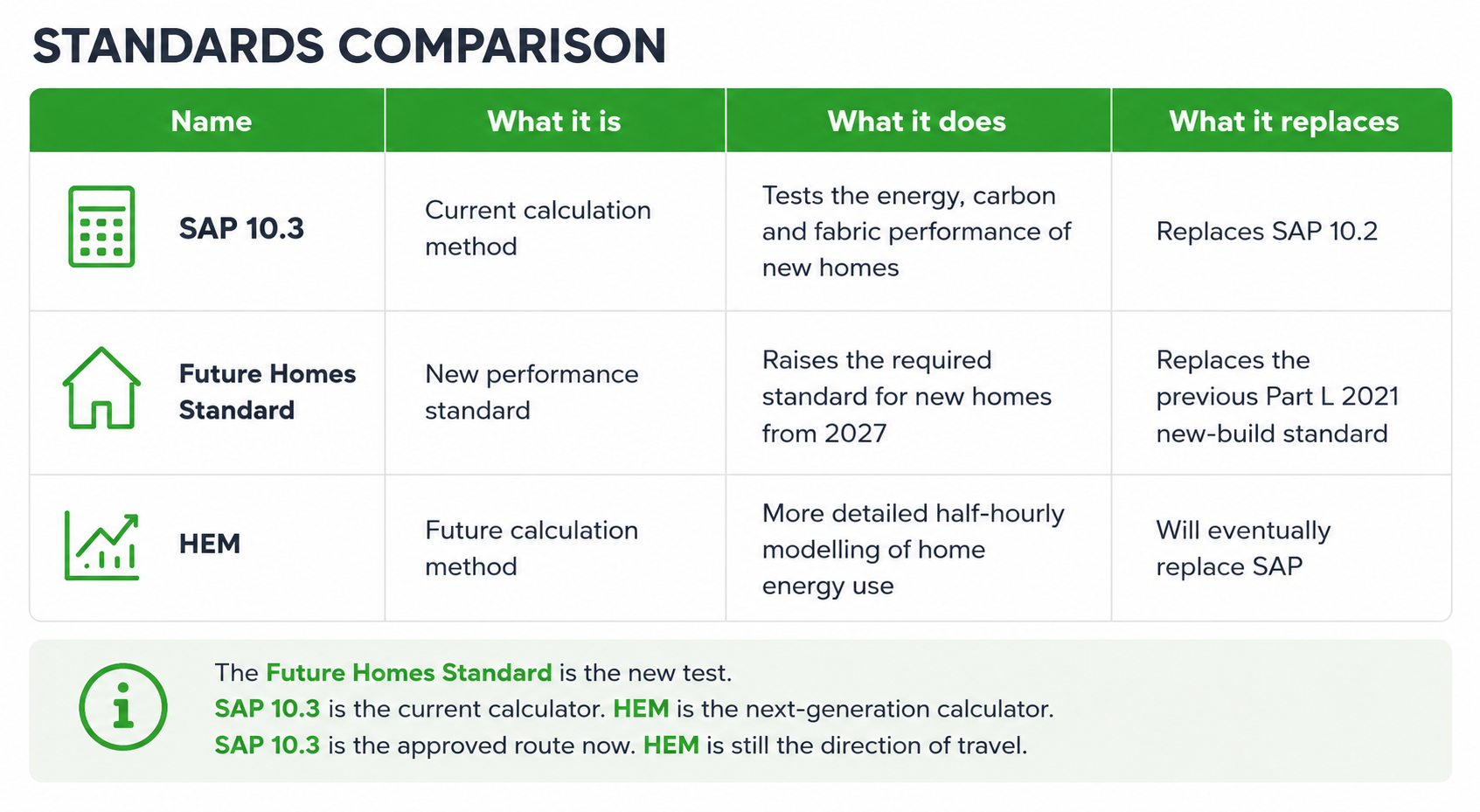
There are three names specifiers and architects need to understand: SAP 10.3, the Future Homes Standard and HEM.
They are connected, but they are not the same thing.
The easiest way to think about it is this:
The Future Homes Standard is the new test.
SAP 10.3 is the current calculator.
HEM is the next-generation calculator.
SAP 10.3 is the approved route now. HEM is still the direction of travel, but it has not fully replaced SAP yet.
That distinction matters because specifiers need to work with the rules that are live today, not the rules we expect tomorrow.
Why This Makes Gas More Difficult
Under SAP 10.3 and the incoming Future Homes Standard, new dwellings are assessed against tougher targets for:
- Carbon emissions
- Primary energy
- Fabric performance
- Heating and hot water efficiency
- Renewable contribution
- Overall dwelling performance
A fossil fuel boiler carries carbon at the point of use. It also brings combustion, flues, ventilation, carbon monoxide considerations, gas safety compliance and future fuel-price uncertainty.
In an older property with high heat demand, gas may still feel familiar and economically attractive, but in a new-build flat with a heat loss of 2 kW or 3 kW, it starts to look like a big piece of legacy infrastructure for a very small heating load.
That is the key change. Modern new builds do not usually need huge amounts of space heating. They need the right balance of fabric, hot water design, renewables, controls, plant space, compliance and capital cost.
So the question for specifiers is no longer:
“Can we fit a gas boiler?”
It is:
“Does gas still make sense once the whole dwelling is assessed?”
Increasingly, the answer is no.
Carbon Offset Payments Matter
Another cost that can be missed early in design is the carbon offset payment.
Many local authorities use Section 106 or local planning policy to charge for residual carbon where a development does not meet the required carbon target on site.
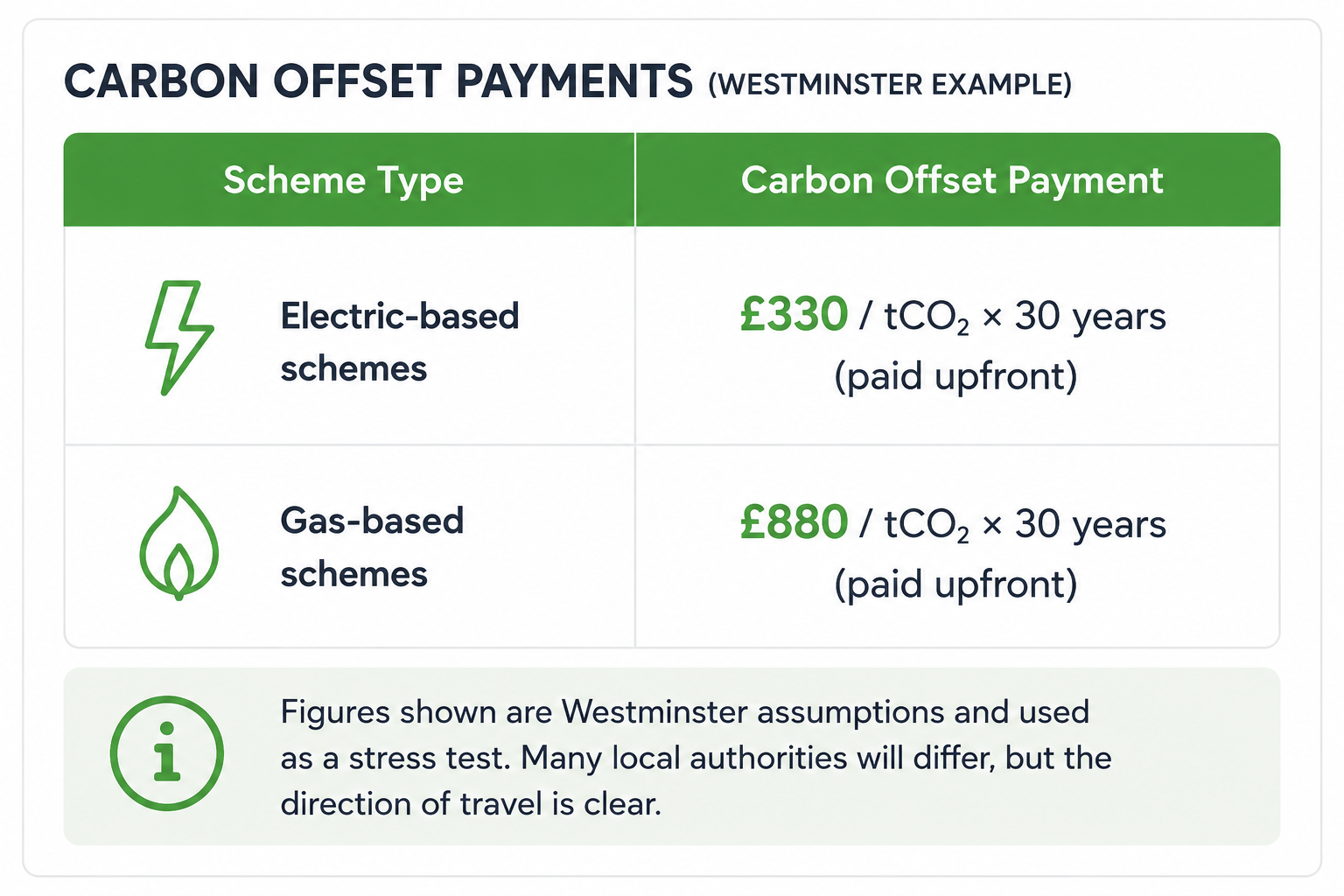
Westminster is a useful stress test because its carbon offset approach is demanding.
For Westminster-style assumptions:
- Electric-based schemes: £330/tCO₂ x 30 years paid upfront
- Gas-based schemes: £880/tCO₂ x 30 years paid upfront
That does not mean every local authority will use those numbers. Many will not, but it shows the direction of travel.
If a fossil fuel option leaves more residual carbon, it can carry a much higher capital penalty. That needs to be included in the heating comparison from the start, not discovered at the end.
HEM Will Make Timing More Important
SAP 10.3 is the live calculation route, but HEM is important because of where the industry is heading.
HEM is designed to model energy use in more detail, including half-hourly behaviour.That matters because real homes use energy in events:
- A shower
- A heating call
- A battery charging
- A battery discharging
- Solar PV generation
- Peak-rate electricity
- Off-peak electricity
- Hot water draw-off
This is where whole-system design becomes more important. An electric boiler should not be assessed only as “direct electric”. It should be assessed as part of a complete dwelling energy strategy.
That may include:
- Low heat loss
- Good fabric
- Wastewater heat recovery
- Solar PV
- Battery storage
- Time-of-use tariffs
- Correct hot water design
- Simple controls
- Matched boiler output
The appliance still matters, but the system matters more.
The Low Energy Demand Paradox
This brings us to ASHP’s and what I call the low energy demand paradox.
The better the building fabric becomes, the less heat the property needs. The less heat the property needs, the harder it becomes to pay back an expensive heating system through annual energy savings.
That is not an anti-heat-pump argument, it is just maths and one which the £7500 grant from the government is trying to hide.
A heat pump may have the best efficiency figure. It may produce the lowest annual bill. But if the installed cost is much higher, and the annual saving is small, the payback can become very long.
That matters in low-heat-loss new-build homes.
A Simple Payback Comparison
To keep the comparison clear, let us look at two low-energy new-build examples.
The first is a smaller property with a 2 kW design heat loss and two occupants.
The second is a larger property with a 4 kW design heat loss and four occupants.
In the larger property, the space-heating demand increases and the hot water demand doubles because the assumed occupancy doubles.
The three product mixes compared are:
Option A: Panel heaters + ASHP hot water cylinder
Option B: Full ASHP wet heating system
Option C: Electric boiler + WWHRS ecosystem
For this model, the figures used are:
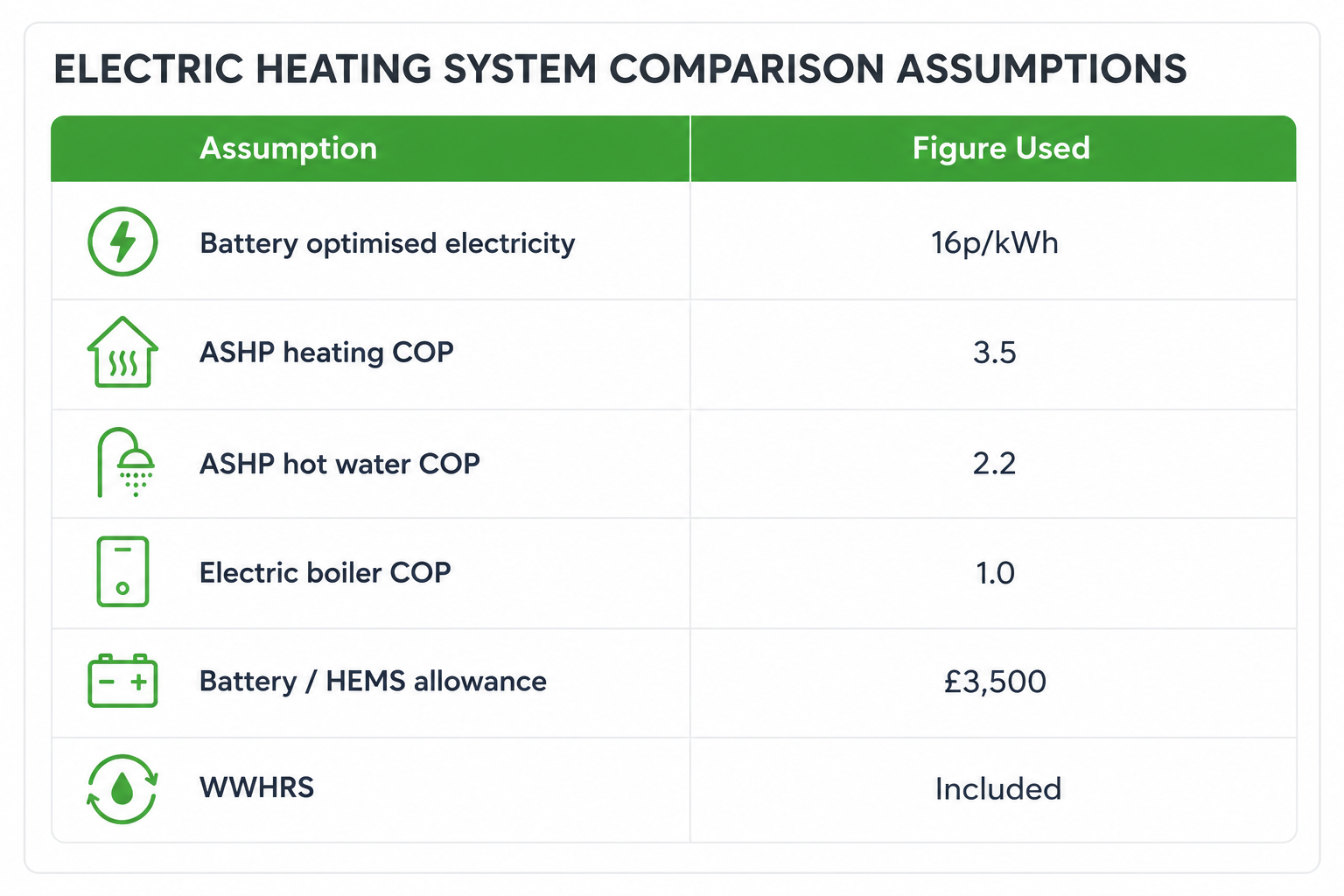
Because all three options are shown using the same battery-optimised electricity rate, the £3,500 battery/HEMS allowance has been added to all three capital costs.
That keeps the comparison fair.
The question is not whether the ASHP has the lower annual running cost. It does.
The question is: Does the ASHP save enough each year to pay back the extra capital cost compared with the electric boiler + WWHRS option?
Property 1: 2 kW Heat Loss, Two Occupants
Assumed annual heating and hot water demand:
|
Demand type |
Annual demand |
|
Space heating |
1,500 kWh |
|
Hot water |
1,500 kWh |
|
Total heating and hot water demand |
3,000 kWh |
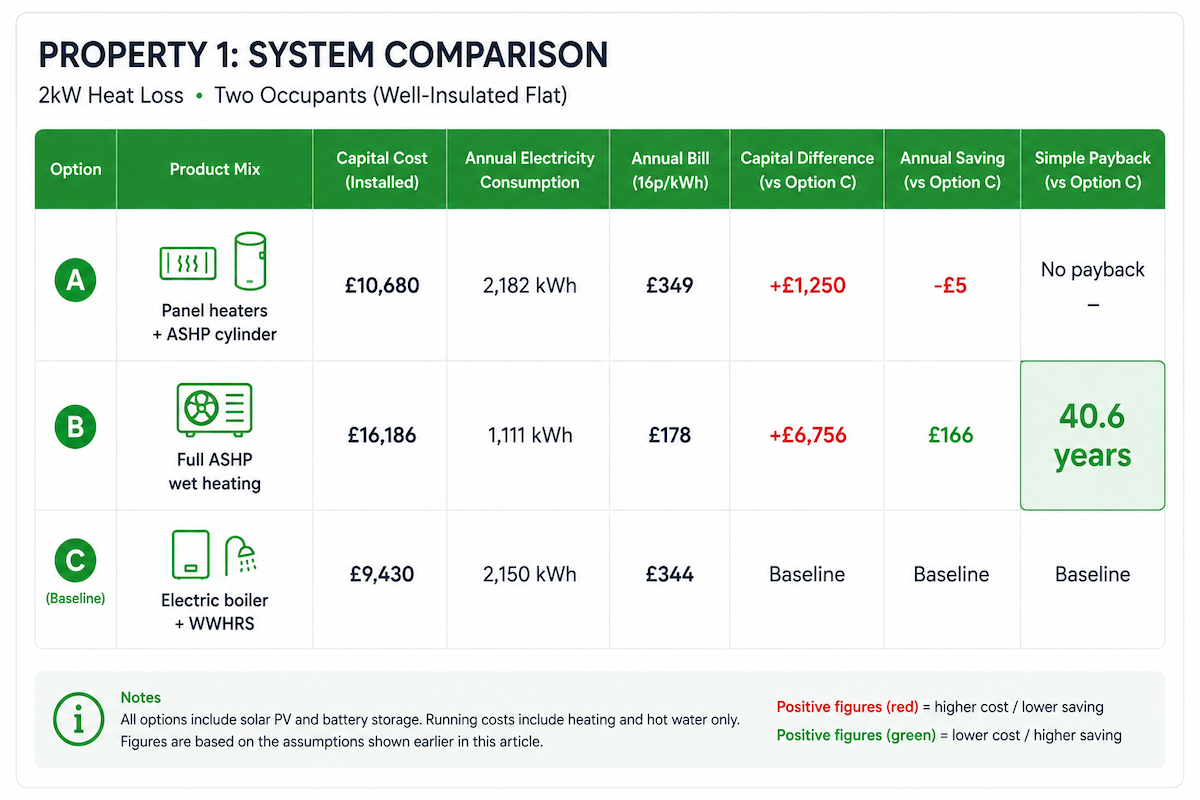
What this means
The full ASHP has the lowest annual bill.
But compared with the electric boiler + WWHRS option, it costs £6,756 more and saves £166 per year.
That gives a simple payback of:
£6,756 ÷ £166 = 40.6 years
In a 2 kW heat-loss property, the ASHP is more efficient, but the annual saving is still small compared with the extra capital cost.
Property 2: 4 kW Heat Loss, Four Occupants
Assumed annual heating and hot water demand:
|
Demand type |
Annual demand |
|
Space heating |
3,200 kWh |
|
Hot water |
3,000 kWh |
|
Total heating and hot water demand |
6,200 kWh |
In this example, the hot water demand doubles because the assumed occupancy increases from two people to four people.
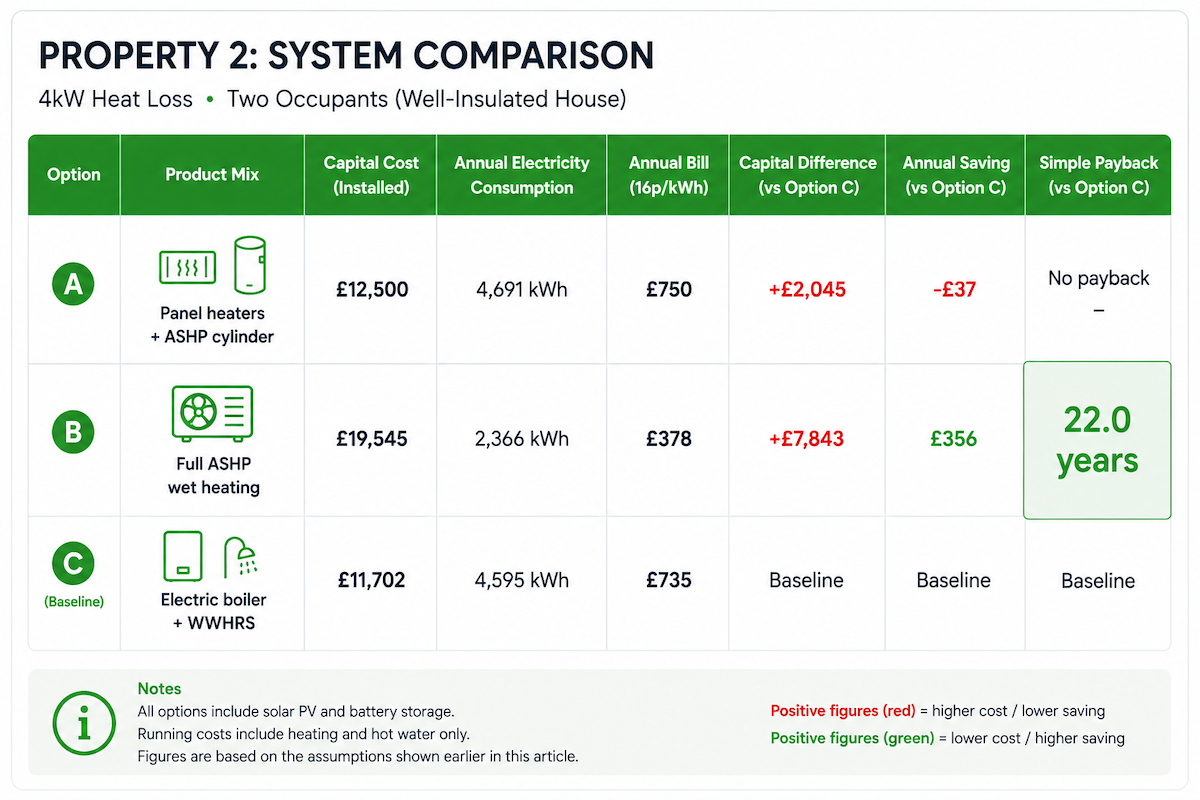
What this means
At 4 kW heat loss, the ASHP case becomes stronger because the annual demand is higher and the hot water demand has doubled.
Compared with the electric boiler + WWHRS option, the full ASHP costs £7,843 more and saves £356 per year.
That gives a simple payback of:
£7,843 ÷ £356 = 22.0 years
The ASHP still has the lower running cost, and at higher demand the payback improves. Unfortunately it is still a long payback period once the capital cost is included and with the energy trust stating an ASHP should have a life of between 15 to 20 years, you may have to spend before you get that money back.
Summary
|
Property |
Total annual heating + hot water demand |
Full ASHP annual saving vs electric boiler + WWHRS |
Extra ASHP capital cost |
ASHP payback vs electric boiler + WWHRS |
|
2 kW heat loss, 2 occupants |
3,000 kWh |
£166/year |
£6,756 |
40.6 years |
|
4 kW heat loss, 4 occupants |
6,200 kWh |
£356/year |
£7,843 |
22.0 years |
This is the low energy demand paradox.
The ASHP is cheaper to run in both examples. That is not being challenged, but in low-heat-loss homes, the annual saving can still be small compared with the extra capital cost.
So the proper specification question is not:
“Which appliance has the best COP?”
It is:
“Does the lower running cost pay back the extra capital cost within a sensible period?”
In these two examples, the answer is difficult, especially in the smaller 2 kW property.
That does not make the ASHP wrong. It simply means the system has to be justified against the property, the heat loss, the hot water demand, the available space, the carbon position, the installed cost and the payback.
A heat pump may be the right answer.
An electric boiler may be the right answer.
The correct answer depends on the property.
Why Hot Water Design Matters
In many new-build apartments, hot water can be a bigger issue than space heating.
A common option is direct electric panel heaters with a standalone heat pump cylinder.
On paper, that can look neat.
But every hot water cylinder has standing losses. Many 200–300 litre cylinders lose around 1.4 to 2.2 kWh per day.
That is roughly:
550–750 kWh per year
just keeping stored water hot.
In a small, low-demand flat, that is not a small amount of energy.
An electric combi has no stored domestic hot water cylinder loss because it heats water on demand. That does not make it right for every property. If the home needs baths, high hot water volume or multiple outlets, a system boiler and cylinder may be the better route.
But in a shower-led flat, an electric combi combined with wastewater heat recovery can be a very sensible design.
Wastewater heat recovery is simple engineering. Warm shower water goes down the drain, and a WWHRS unit uses some of that heat to pre-warm the incoming cold mains.
The boiler then has less work to do.
No magic. Just a useful passive heat exchanger.
What This Means for Specifiers and Architects
The role of the specifier is changing.
It is no longer enough to ask:
“What heating appliance do we normally use?”
The better questions are:
- What is the actual heat loss?
- Is the property shower-led or bath-led?
- Is there space for a cylinder?
- Is there space for an outdoor unit?
- Will acoustic requirements be an issue?
- What does SAP 10.3 show?
- What would future HEM-style modelling reward?
- Is there solar PV?
- Is there battery storage?
- Can WWHRS reduce hot water demand?
- What is the carbon offset position?
- What is the installed cost?
- What is the payback?
- What is easiest for the customer to live with?
That is a more honest conversation.
Sometimes the answer will be a heat pump.
Sometimes it will be a communal system.
Sometimes it may be a system boiler and cylinder.
And in the right low-heat-loss, shower-led property, an electric combi plus WWHRS may be the most sensible answer.
Where EHS Flex Fits
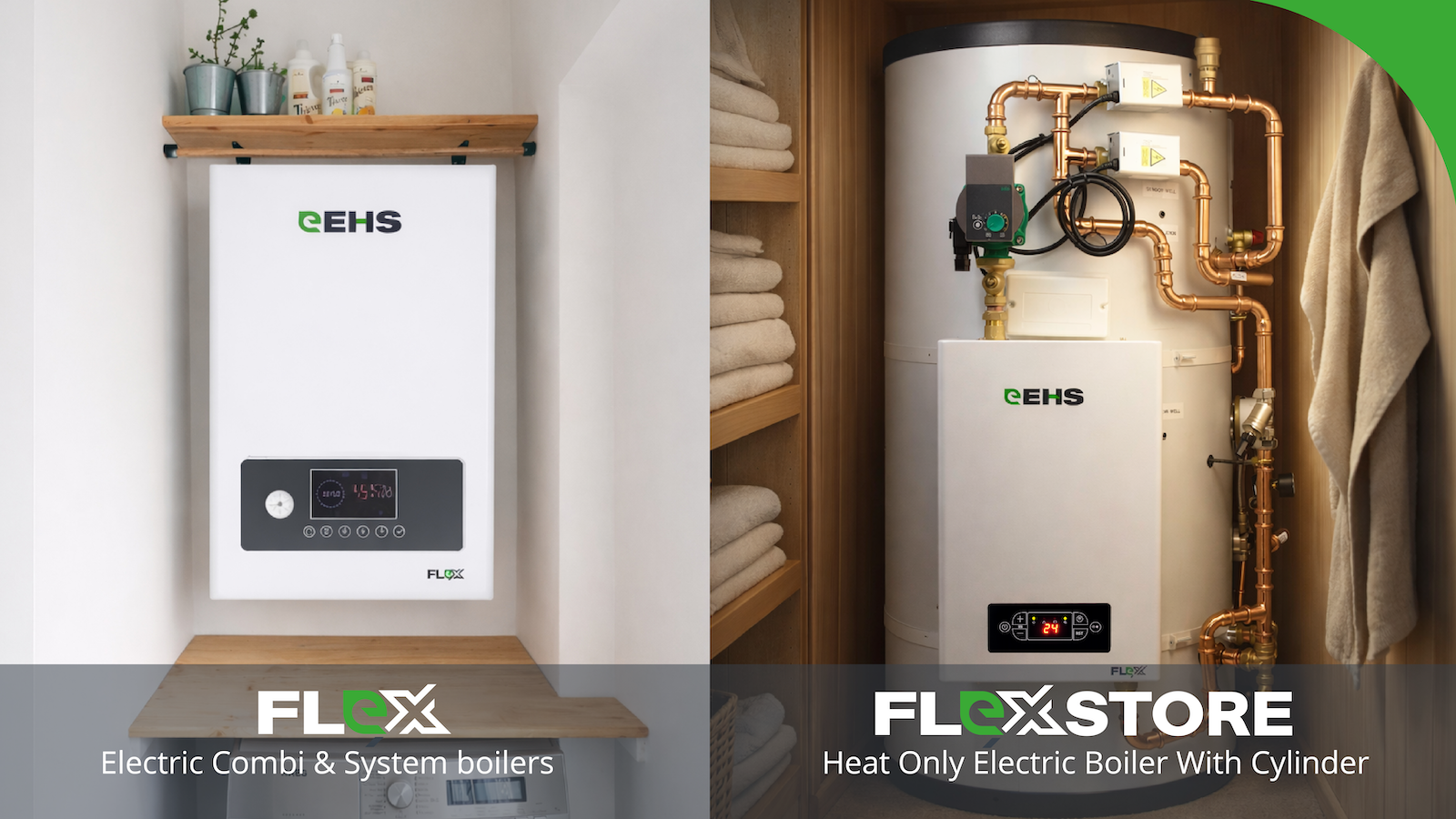
The EHS Flex range is built around matching the boiler to the property.
Flex Combi Boiler
Best suited to smaller homes, flats and apartments where hot water demand is mainly shower-led and the customer wants compact heating and hot water without gas, flue, cylinder or outdoor plant.
Flex System Boiler
Better where stored hot water is required, especially where there are baths, higher hot water demand or multiple outlets.
Flex+
Designed for constrained supplies, including park homes, holiday homes, annexes and similar properties where managing the available electrical supply is central to the job. The boiler does this autonomously, by continually monitoring the incoming supply and adjusting the boiler power to only use the available headroom if needed.
Heat Only Boiler
The EHS heat only boiler is a simple, range-rateable electric heat source designed to be matched to the property’s actual heat loss. With no internal pump, it gives installers more control over the hydraulic design, making it well suited to underfloor heating, manifolds, zoning and low-temperature circuits.
FlexStore
FlexStore is designed to make electric heating and hot water installations quicker, neater and more consistent. With key components preassembled, it reduces site work, pipework and installation time, helping installers deliver a cleaner, more efficient system with fewer decisions needed on site.
The principle is simple:
Match the boiler to the building.
Bigger is not automatically better. Gas worked well for a long time because the buildings, the regulations and the economics suited it.
New-build homes are now moving in a different direction.
Better fabric.
Lower heat loss.
Tighter carbon targets.
More solar PV.
More battery storage.
More attention on hot water.
More pressure on plant space, safety and compliance.
That does not mean one technology wins everywhere.
It means the old default answer is no longer good enough.
The future of new-build heating will be won by better specification: fabric first, hot water understood, carbon properly accounted for, and the heating system matched to the property.
Compare the whole system, not just the appliance.